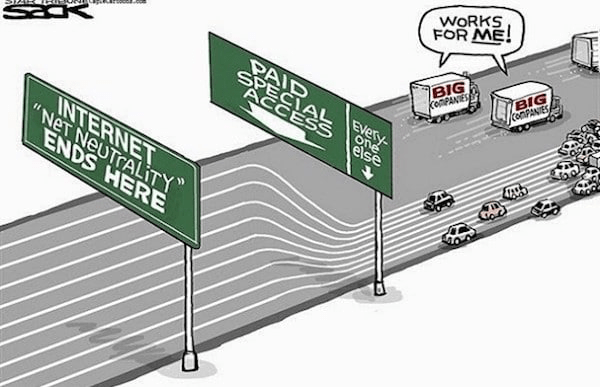
According to Medium.com is “a series of rules centered on the idea that Internet Service Providers must service customer requests in a way that is agnostic to data being provided. Net neutrality has a long history in American politics that predates The Internet by many years,” but how would this effect you and me?
It all started with the 32nd U.S. President, Frederick D. Roosevelt, and the passing of the Communications Act of 1934. When this law was passed, the FRC (Federal Radio Commission), with the Federal Communications Commission, or the FCC. The FCC is used to regulate upcoming technologies (during that era) which included: broadcasting television and telephony. This act gave the FCC the power to classify a communication organization as a “common carrier”.
New Deal politicians blamed the laissez-faire policies on the strong monopolies. As a result, they didn’t want this situation to repeat itself. By passing the Communications Act of 1934, power companies weren’t capable of monopolizing.
Fast forward to 1996, the Telecommunications Act of 1996 was passed the transmission of those services over the existing telephone network would remain as a common carrier. This makes perfect sense: websites aren’t transporting your 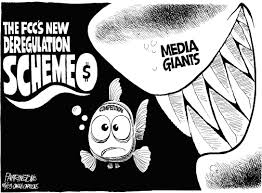 data anywhere — they receive your request and respond to it; the ISP transports those requests and responses. However, the 1996 act abstained from classifying the new cable broadband Internet Service Providers under Title II, leaving this new “high speed” Internet industry essentially unregulated. In addition to this lack of classification, the 1996 law sought to reduce regulatory barriers to entry in both telecom and broadband by softening the laws of the previous regime as set in the 1934 act.”
Tim Wu, a University of Virginia professor, argued that “the promotion of network neutrality is no different than the challenge of promoting fair evolutionary competition in any privately owned environment, whether a telephone network, operating system, or even a retail store. Government regulation in such contexts invariably tries to help ensure that the short-term interests of the owner do not prevent the best products or applications becoming available to end-users. The same interest animates the promotion of network neutrality: preserving a Darwinian competition among every conceivable use of the Internet so that the only the best survive.”
“What about the debate that constantly influx the news?”
Well, there are two sides with their own opinions. One side (that consists of commoners like you and me) will argue that net neutrality is what keeps the internet from becoming monopolized and keeps the relations between the consumers and businesses equal. On the other hand, “Many tech companies and internet activists feel differently. They say that internet service providers can throttle speeds, charge more for faster service or block websites and apps if not regulated more closely by government,” myajc.com says, “Republicans have largely sided with internet providers, while tech giants like Google and Facebook, civil liberties groups and Democrats have backed the Obama-era rules.”

In 2015, 49 Democrats and 3 Republicans from the Senate approved of Net Neutrality. However, with recent Presidential elections resolving with Trump victorious, Congress becomes prominently Republican; meaning that businesses can adjust to their standards (speeding or slowing internet speeds as they please).
Recently, the FCC Chairman, Ajit Pai, voted to ban Net Neutrality, and the internet, news, and social media had their opinions flooding. “Supporters of net neutrality say that it protected everyday Americans from having their internet slowed down or their favorite websites blocked by a greedy, evil internet service provider. Others have said net neutrality made sure free speech wasn’t stifled by ISPs. These claims are nothing more than myths,” FOX news claims, “Market forces already protected consumers, because if an ISP started deliberately slowing down people’s favorite websites and streaming services, or putting an end to free speech, consumers would simply switch to a different ISP.”
Many believe that Net Neutrality is what keeps the world grounded. By banning it, we’ll have to find out what happens next…
 Digitech